

about
Olga Radović is a Serbian pianist and composer based in New York City whose work spans performance, composition, and education. Trained as a classical pianist, she has performed throughout Europe, China, and the United States, appearing at festivals including the Beijing International Music Festival, the Bergen International Festival, and the Decoda Chamber Music Festival.
In recent years, Radović has increasingly turned toward composition, writing primarily for chamber ensembles, piano, and voice. Highlights of the 2025/2026 season include performances at the St. Thomas Sunday Recital Series, Ukrainian Contemporary Music Festival (UCMF), Every Woman Biennial, and SongSlam NYC 2026.
She holds degrees from the University of Arts in Belgrade, the University of Connecticut, and the Mannes School of Music at The New School, where she was awarded the Newton Swift Award.
artist statement
My compositions often evolve from simple gestures or melodic fragments, shaped through sensory imagination and exploration. I am drawn to working with a small number of musical “seeds,” allowing them to grow into distinct shapes and forms through experimentation with rhythm, instrumental dialogue, and timbre. Early in the process, I often recognize something familiar or everyday in the material, and I begin to associate the piece with a specific action, event, or emotional state that supports its development.
I often start away from the piano, usually singing, humming, moving through my room to evoke the motion, rhythm and dynamic of the musical ideas. What kind of motion do I want the piece to suggest? Is it expansive or restrained? I think about how I want the music to feel if I could touch it: smooth like silk, dense like cotton, ribbed like corduroy, or light like chiffon? If it were a human interaction, would it be a hug, heated exchange, or an intimate dance? How would it smell? If it were words, what would be said, and in what voice? If it were an image, what would it hold, what colors would emerge?
I gravitate toward writing pieces as small, dynamic worlds; miniatures or collections of movements that resemble short stories. I admire authors such as Dino Buzzati, Isaac Bashevis Singer, and Anton Chekhov, whose works immerse the reader immediately, without excess or hesitation. What I value most in their writing is the way they draw attention to the seemingly mundane and transform it into something vivid and, sometimes, fantastical. There is something special about how ordinary events, everyday actions, and the human condition, often embodied through “small,” overlooked characters can become deeply expressive and meaningful.
As a sensitive person, bringing attention to the ordinary helps me navigate a world that can feel overwhelming or unjust. These small, often overlooked moments of connection are, to me, what helps me feel connected to the people and world around me. They are the driving elements in building my pieces.
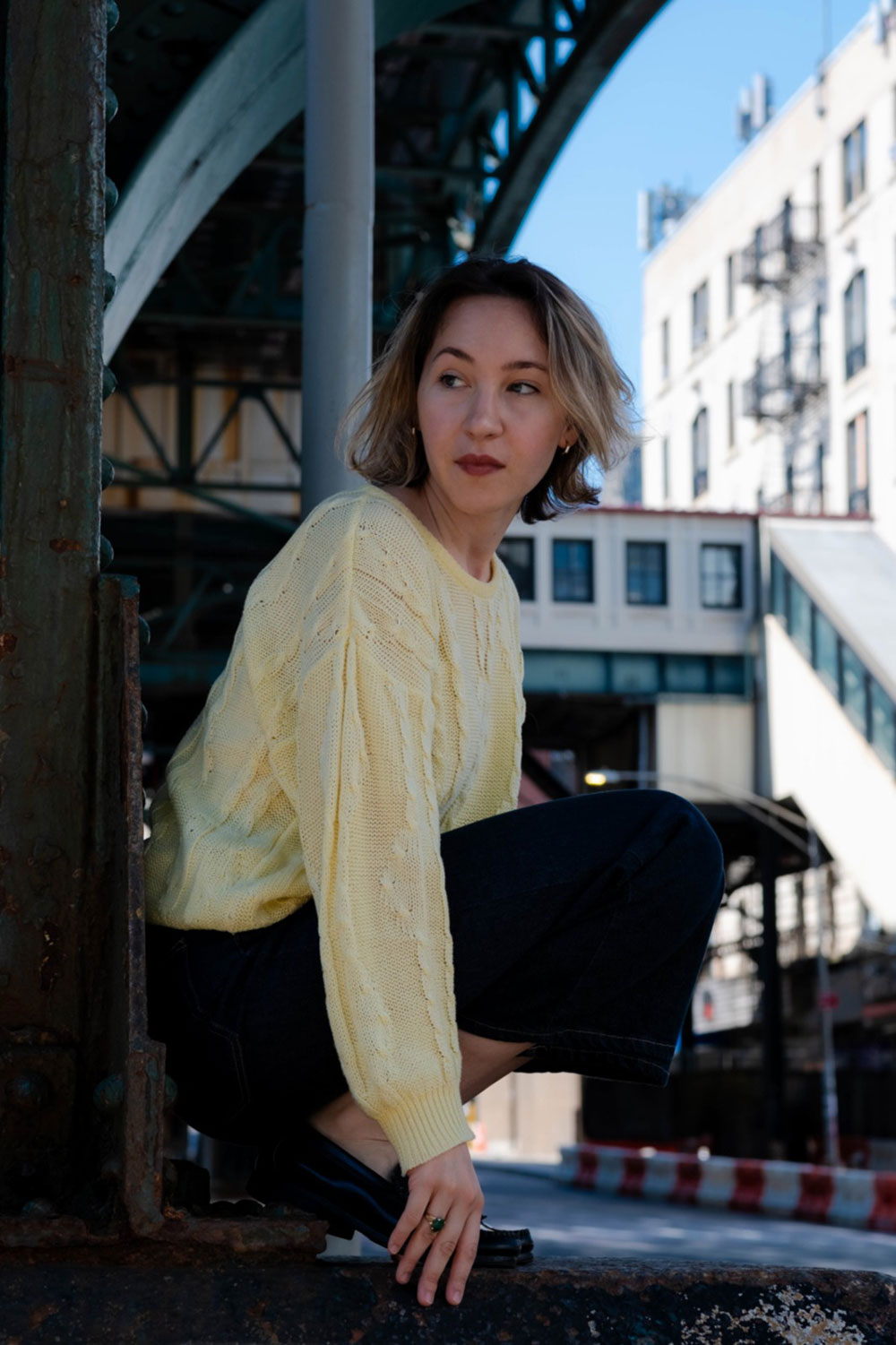
Photo by Georgina Wu @georgina0101